Blue Socks Woman Social Tag
Just DesertsThe concept of the blue-stocking is a socially loaded label applied to intelligent women, especially when their learning or independence unsettles conventional expectations of femininity. Its importance lies in the contradiction it reveals: a woman may be praised for beauty and tolerated for intelligence, yet the same intelligence becomes suspect when it is associated with plainness, an unfashionable figure, or an unwillingness to remain decorative. The label therefore turns cultural knowledge into a test of gender conformity, while allowing men and other social observers to dismiss female authority as eccentricity or unattractiveness.
Meaning and Social Use
Mrs. Gardiner explains that “blue-stocking” is not a simple description but a term carrying “all sorts of double meanings, nuances and layers.” It is used chiefly as a taunt against clever women, particularly those whose intelligence makes stupid men feel intimidated. The insult does not merely criticize what a woman knows. It attempts to place her knowledge outside acceptable womanhood, converting intellectual ability into evidence that she is difficult, unfeminine, or socially undesirable.
The label also has a marked appearance-based bias. Clever women who are plain or not considered sufficiently womanly are called blue-stockings more often than equally clever women who are attractive. The distinction makes clear that intelligence is not judged independently of the female body. A woman’s beauty can soften or conceal the social threat associated with her mind, while a woman who lacks conventional attractiveness is more readily reduced to a caricature of the learned, socially awkward female. The category thus joins cultural judgment to the policing of women’s bodies.
Elizabeth Bennet and the Threat of Classification
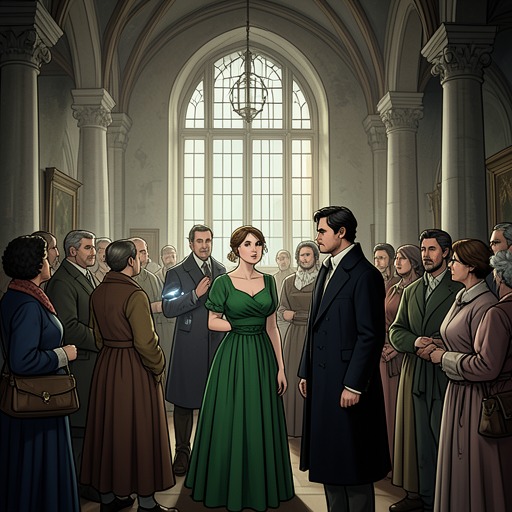
Elizabeth asks directly whether she is a blue-stocking, and the guarded glance exchanged by Edward Gardiner and Madeline Gardiner effectively answers before the explanation begins. Her question is not abstract. Elizabeth is already known as unusually active, questioning, and intellectually engaged, and her relatives are helping her become more visible in London society. The possibility that this visibility may produce a label reveals the risk attached to her development: the more fully she speaks and acts, the more easily society can classify her as an improper kind of woman.
Elizabeth’s response is characteristically self-aware and ironic. She asks whether she is too pretty and too curvaceous to receive the name, exposing the absurd standard by which female intelligence is measured. Her remark makes the social logic visible: the issue is not whether she possesses learning, but whether her appearance permits others to find that learning acceptable. Edward Gardiner’s choking and coughing at the moment further underscores the discomfort produced when the rule is stated plainly. Elizabeth refuses to let the label remain a flattering or harmless description; she forces its connection with sexual attractiveness and social prejudice into the open.
Charlotte Lucas comes immediately to Elizabeth’s mind because Mrs. Bennet’s continual put-downs have supplied a personal example of the same injustice. Charlotte’s position demonstrates how the label works alongside other forms of female judgment. A woman can be intellectually capable and still be treated as deficient because she is not considered attractive enough, socially exciting enough, or romantically valuable enough. Elizabeth’s anger is therefore not directed only at an individual insult. It arises from recognizing a system that turns women against one another while preserving appearance as the final measure of worth.
Knowledge, Labor, and Female Authority
The narrative repeatedly gives Elizabeth forms of knowledge that are practical rather than ornamental. Lady Radha Pentland gradually teaches her how to become the lady of an estate through conversation and shared experience, not through a formal curriculum. Elizabeth learns about estate management by observing a woman who sets household menus while also acting as a helpmate to Sir David Pentland across the estate’s affairs. The education presents female competence as sustained work: judgment, administration, attention to tenants, and the ability to connect domestic organization with wider responsibility.
Elizabeth’s intellectual development also becomes a source of personal stability. Her time with the Pentlands and her correspondence with the Harkness sisters channel her energy into purposeful activity, allowing her to describe the ideal as being “calmly active.” She reads practical books on estate management, persuades Thomas Bennet to obtain additional volumes, and studies beside him even when their intellectual companionship remains incomplete. Her learning is consequently not a pose adopted to gain distinction. It is a method of becoming useful, of feeling valued, and of acquiring the capacity to manage responsibilities that society often leaves women undereducated to assume.
The same principle extends to her understanding of tenants and servants. Elizabeth learns that the welfare of an estate’s tenants belongs to its master’s responsibility, while also recognizing that tenants themselves taught her and Jane Bennet how assistance should work. Her knowledge is relational and experiential rather than merely theoretical. Later, with Edward and Madeline Gardiner, she learns the practical management of a substantial household: maintenance and cleaning schedules, weekly menus, the work of a housekeeper and cook, and the constraints involved in organizing domestic life. These scenes challenge the idea that female household expertise is natural, trivial, or intellectually negligible. They show it as a body of knowledge acquired through observation, labor, and judgment.
From Insult to Alternative Social Practice
The blue-stocking label belongs to the same social world that gossips about women’s sexuality, pregnancy, reputation, and personal relationships. In Meryton, women repeat stories about an unmarried young woman sent away because she was with child; in the Ton, gossip about Elizabeth Bennet being Fitzwilliam Darcy’s mistress spreads through insinuation and carefully qualified phrases such as “I am led to believe” and “the latest rumour is.” These practices create a climate in which women are reduced to reputations produced by other people’s speech. Calling a woman a blue-stocking is part of the same classificatory machinery: a quick social verdict replacing attention to the person’s actual conduct.
Elizabeth’s answer is not to abandon learning or conceal her practical abilities. Instead, she builds relationships and institutions in which women’s knowledge has material consequences. Her education with Lady Radha Pentland, her collaboration with the Gardiners, her work connected with the Asylum for Female Orphans, and her determination to preserve the Grenadine Reef dower house as a genuine refuge for women all convert competence into protection. The refuge is to remain self-contained, supplied with food and provisions, and supported by continuing funding and transportation. Such arrangements make female agency visible not as a fashionable intellectual identity but as administration, care, recovery, and control over resources.
This alternative also changes the meaning of social approval. The women who apply the label assume that female intelligence must be balanced by beauty, marriageability, or submissiveness. Elizabeth’s life demonstrates another standard: a woman’s value can be measured by what she understands, manages, teaches, and sustains. Her hidden wealth and later identity as a wealthy widow make secrecy necessary because fortune hunters and rakes would be drawn to her money, yet her refusal to define herself solely through the title of Lady Pentland preserves a different kind of authority. She understands that Lady Radha Pentland was the woman whose thirty-five-year marriage gave that title its true meaning, while Elizabeth’s marriage to Sir David Pentland lasted barely thirty-five hours. Her self-definition resists the social tendency to turn a woman into a label, whether blue-stocking, widow, mistress, or title-holder.
Thematic Significance
The concept dramatizes a central gender double standard: women are encouraged to cultivate qualities that society may later use against them. Learning can make a woman admirable when it remains decorative, but threatening when it produces independent judgment, economic competence, or public usefulness. The insult also reveals how gendered reputation operates through an intersection of cultural capital and physical evaluation. Intelligence is acknowledged, but only after being filtered through the question of whether the woman possessing it is attractive enough to excuse it.
Elizabeth’s story ultimately reverses that hierarchy. She does not defeat the label by proving that she is beautiful, nor by apologizing for being educated. She exposes the label’s dependence on male insecurity and social cruelty, then lives according to a broader model of womanhood grounded in practical intelligence, mutual care, estate responsibility, charitable action, and marriage as partnership. The blue-stocking is therefore less a reliable category than evidence of the society that needs such categories. Its sharpest function is diagnostic: it shows who is threatened when a woman speaks with knowledge and acts with authority.